I have a love-hate relationship with Lent.
For the unaware, the season of Lent begins forty days before Easter. Like the holy days of Christmas and Easter, Lent was a later invention of the Church. The season recalls Jesus being led by the Spirit into the wilderness for forty days after his baptism. There he fasted and was tempted by the devil. The Lenten season even suggests the forty years that the Israelites wandered in the desert. There God prepared and shaped them for life in his promised land. Lent is a time for repentance, prayer and fasting as we anticipate the glory of Jesus' resurrection.
As Christians, we rely only on the grace found in Jesus Christ. Despite the fact that we are undeserving, God continues to love us. Only through God's actions in Jesus, am I reconciled to God. That belief makes me cast a suspicious eye on Lent. Are we trying through our own piety to manipulate God to love us more? If so, it is a foolhardy attempt.
In 1522, a group of Christians in Zurich heady with the profound knowledge of God's grace ate sausages during Lent. The simple defiant act of eating meat during the prescribed fast threw the city into an uproar. The Reformation came to Zurich, and the disciplines of Lent demanded by the Church were rejected.
Christians like grace. As a small child, I asked my parents, "How do I know that I've done enough to get into heaven?" The answer is that God's love and mercy is sufficient for you and me. However, many Christians who embrace God's grace have forgotten about its high cost. Grace doesn't cost us anything, but God paid a heavy price. Jesus, our Emmanuel, suffered and died on a cross bearing the sins of the world. This costly grace calls us to faithfulness. We live lives of prayer, worship, and sacrifice. We delve into the Scriptures to understand better our Lord. We forgive, love and show mercy because of the grace that we have received.
No season is better than another. Still if we decide to spend Lent reflecting on the incredible cost of God's grace and our response, it will be time well-spent. If the disciplines of Lent are less about us and more about God, the time can be redeemed. As we enjoy our sausages, let us also be shaped for the life God intends.
Tuesday, February 27, 2007


Monday, February 05, 2007
Super Bowl Win
 Sports and Christianity have had a long tradition together probably dating before the formation of the YMCA in 1844. Prayers before games and players who attribute their wins to Jesus have become part of the pop culture. In fact, the latter has been parodied again and again. I must admit that some declarations of faith on the field appear to suggest that God favors one team over another. The statements are usually innocent, but I still cringe at the mixture of religion and athletic rivalries. Perhaps, that is why I was so impressed by the words of Tony Dungy, the coach of the 2007 Super Bowl Champions, the Indianapolis Colts.
During the post game show on CBS, Dungy was asked about the “social significance” of the win.
Jim Nantz of CBS Sports: This is one of those moments, Tony, where there is also social significance in this victory, and to have your hands on the Vince Lombardi Trophy. Tell me what this means to you right now.You can win doing it the Lord’s way. He is not saying that God chose the Indianapolis Colts. More importantly, he is saying, in the world of professional sports, you don’t have to give into temptation. You can play by God’s rules and still win.
Tony Dungy: I'll tell you what. I'm proud to be representing African-American coaches, to be the first African-American to win this. It means an awful lot to our country. But again, more than anything, I've said it before, Lovie Smith and I, not only the first two African-Americans, but Christian coaches showing that you can win doing it the Lord's way. And we're more proud of that.
Both Tony Dungy and Lovie Smith, the Chicago Bears’ coach, act differently than other coaches. One commentator speaking about Tony Dungy says…
He has always done what good men do, eschewing the tyrannical approach of some of his colleagues, proving you can succeed while treating people with decency and respect rather than terrorizing them.A Boston Globe column talking about Lovie Smith says…
Lovie doesn't yell and Lovie doesn't swear. (The same is true of Lovie's friend, Tony Dungy.) Take both of those options away and at least half of America's professional and college coaches would not be able to function. So how does he make his points?Character matters. For Tony Dungy and Lovie Smith, character has it’s source in their Christian faith.
"We have a coach who isn't a yeller or a screamer," acknowledges cornerback Nathan Vasher. "What he always talks about is being a real man, and we have real men on this team. What he wants us to know is that it is not about you. It's about the team."
Thursday, January 04, 2007
Christian vs Christ Follower
This video is part of a series made by Christ Community Church. I found the series after reading about it on a discussion board at allelon.org. I know nothing about the church except from their website, and any criticism of the videos is not directed toward the church or its members.
The video borrows the format of those PC vs. Mac advertisements. These commercials basically suggest that PCs are fuddy-duddy and Macs are cool. In this version, the fuddy-duddy is the “Christian” and the hipster is the “Christ follower”. Throughout the series of videos, there are slams on Christian bumper stickers, WWJD bracelets, the contemporary Christian music genre, dressing up for church, self-righteousness, and having faith for show. The “Christian” is a cartoon character who garners no sympathy. Frankly, I want to be the “Christ follower” who dresses casually for church, listens to U2, and has a Christian walk which requires no accoutrements. Still, the whole thing smacks of “I’m better than you.”
By calling the dweeb, “Christian,” the video is attempting to be controversial. The world is full of self-professed Christians who represent the faith sometimes better and sometimes worse. All these Christians are lumped together and labeled less than faithful. We look over at the “Christian,” and say, “Thank you, God, that I am not like this dork over here.” These are Pharisees who sat at the cool kids table in middle school.
The real lesson for each of us is that the sin of self-righteousness is always near. We think debates about Christ, the church, and the Scriptures are important ones. We hold positions that we believe are correct. Otherwise we wouldn’t hold them. Nonetheless, our rightness does not forgive our arrogance or blindness to our own sins.
Monday, January 01, 2007
Lefsa is Lotus
While traveling to Ohio to visit family, we had a short layover in Minneapolis, Minnesota. Normally, airports look and feel all the same. If you’ve seen one, you’ve seen them all. Walking from one gate to another, Chicago could be St. Louis. Kansas City could be Cleveland. A layover rarely allows anyone to experience the locale in any meaningful way.
This layover was different. Among the many announcements on the loudspeaker, I heard,
Sadly, I could find no krumkake for the Christmas holidays. Uff-da.
This layover was different. Among the many announcements on the loudspeaker, I heard,
“Someone has left a bag of lefsa at the security area. Please report to the security area and describe your bag to claim your lefsa.”Lefsa is a traditional Norwegian flatbread made of potatoes. With that announcement, I knew that I could only be in Minnesota.
Sadly, I could find no krumkake for the Christmas holidays. Uff-da.
Thursday, December 28, 2006
Why Are Unicorns Hollow?
Before becoming a pastor, I taught a few years of mathematics in a high school. Although my time there was short, they made a great impression on me. Those years have influenced and shaped my thinking ever since. My only regret is for the poor students who suffered me as a teacher. I was fresh out of college and ready to take on the world.
In high school, I had loved geometry. Using reason alone, so I thought, we reconstructed the world. I loved the objectivity and rationality that it proclaimed. When I was the teacher, I tried to instill that same sense in my students. The first day of geometry class, I read to them from Descartes’ "Discourse on the Method." (I told you that my students suffered.)
Anyway, the year was an utter failure. I learned that geometry was not merely a collection of givens, postulates, axioms, and theorems. Beyond reason, there were hunches, hints, and guesses involved. Observation, past experience, and even tradition were important. Students had to learn to think, and this process was more than a system of rational deduction.
I remembered this hard-earned knowledge while reflecting on Richard Dawkins. The author of "The God Delusion" has been getting a bunch of press lately. Dawkins is an avowed atheist, zealous in his attacks on religion. Where many are suggesting that science and religion can be in dialogue, Dawkins will grant no ground to religion. In fact, God should be excised from human thought. Recently I heard a recent podcast of "To the Best of Our Knowledge" from Wisconsin Public Radio which included an interview with Dawkins.
Although the interviewer Steve Paulson asks some intriguing questions that deserve more commentary, I was more interested in hearing what Dawkins had to say.
Throughout the history of humanity, people have wrestled with a variation of "What is the purpose of life?" Dawkins basically suggests that they were all wasting their time. Plato, Aristotle, Moses, Jesus, Mohammed, Buddha, Lao-Tse, Augustine, Aquinas, Luther, Calvin, Hobbes, Locke, Jefferson, Hume, Rousseau, Kant, Hegel, Marx, and even Nietzsche did not think that the question was illegitimate. Of course, each of them would probably find serious disagreement with the others, but that’s not the point. Richard Dawkins suggests that he is smarter than all these guys. With a turn of the phrase, he says the question that has dominated human thought for ages is out-of-bounds.
Later, Dawkins tries to explain why he thinks such thought "begs the question."
Dawkins himself is begging the question. Like I did with my students, Dawkins has required a truncated view of human knowledge. If something doesn’t fit with his world view, he proclaims it illegitimate. He sounds as bad as the fundamentalists that he decries.
In high school, I had loved geometry. Using reason alone, so I thought, we reconstructed the world. I loved the objectivity and rationality that it proclaimed. When I was the teacher, I tried to instill that same sense in my students. The first day of geometry class, I read to them from Descartes’ "Discourse on the Method." (I told you that my students suffered.)
Anyway, the year was an utter failure. I learned that geometry was not merely a collection of givens, postulates, axioms, and theorems. Beyond reason, there were hunches, hints, and guesses involved. Observation, past experience, and even tradition were important. Students had to learn to think, and this process was more than a system of rational deduction.
I remembered this hard-earned knowledge while reflecting on Richard Dawkins. The author of "The God Delusion" has been getting a bunch of press lately. Dawkins is an avowed atheist, zealous in his attacks on religion. Where many are suggesting that science and religion can be in dialogue, Dawkins will grant no ground to religion. In fact, God should be excised from human thought. Recently I heard a recent podcast of "To the Best of Our Knowledge" from Wisconsin Public Radio which included an interview with Dawkins.
Although the interviewer Steve Paulson asks some intriguing questions that deserve more commentary, I was more interested in hearing what Dawkins had to say.
According to Dawkins, the question, "What is the purpose of life?" is completely illegitimate. The question is as pointless as asking, "Why are unicorns hollow?" As a committed follower of Jesus Christ, I disagree. That probably wouldn’t surprise anyone. However, I find the statement bizarre on a completely rational level.Interviewer: What about the old adage that science deals with the "how" questions and religion deals with the "why" questions?"
Dawkins: Yes, I think that is markedly stupid if I may say so. What on earth is a "why" question? There are "why" questions that mean something in a Darwinian world. We say, "Why do birds have wings to fly with?" They don’t mean that. They mean "why?" in a sort of deliberative purposeful sense. Those of us who do not believe in religion, supernatural religion, would say, there is no such thing as a "why" question in that sense.
Now the mere fact that you can frame an English sentence with the word, "why," does not mean that English question deserves or should receive an answer. I could say, "Why are unicorns hollow?" That’s a perfectly good English sentence. It appears to mean something but you don’t think that it deserves an answer.
Interviewer: But it seems to me that the big "why" questions are, "Why are we here?", "What is our purpose in life?" Okay, that’s a "what" question. But it’s basically a "why" question.
Dawkins: That’s right it is a "why" question, but it’s not a question that deserves an answer.
Interviewer: But I think most people would say those questions which are central to the way most people think about their lives. Those are the big existential questions. But those are also questions that are beyond science.
Dawkins: If you mean what is the purpose of the existence of the universe that quite simply is begging the question. If you happen to be religious you think that’s a meaningful question. Those of us who do not believe in a god, will say, that is as illegitimate as asking, "Why are unicorns hollow?" It just shouldn’t be put. It is not a proper question to be put. It does not deserve a answer.
Throughout the history of humanity, people have wrestled with a variation of "What is the purpose of life?" Dawkins basically suggests that they were all wasting their time. Plato, Aristotle, Moses, Jesus, Mohammed, Buddha, Lao-Tse, Augustine, Aquinas, Luther, Calvin, Hobbes, Locke, Jefferson, Hume, Rousseau, Kant, Hegel, Marx, and even Nietzsche did not think that the question was illegitimate. Of course, each of them would probably find serious disagreement with the others, but that’s not the point. Richard Dawkins suggests that he is smarter than all these guys. With a turn of the phrase, he says the question that has dominated human thought for ages is out-of-bounds.
Later, Dawkins tries to explain why he thinks such thought "begs the question."
Dawkins: ...A legitimate question is "Where do the laws of physics come from?" An illegitimate question in my view is "What is the purpose of the laws of physics?" That implies that there is some kind of deliberate purpose-giver or purpose-thinker...Perhaps, there is a begging of the question. Perhaps, there is an assumption of a purpose-giver. However, human history has suggested many purpose-givers, and most do not require a deity. Besides God, other possible purpose-givers have included nature, reason, history, wealth, or race to name a few. Some have suggested that humanity itself is the purpose-giver. Still others have claimed answered the question, "What is the purpose of life?" with, "There is no purpose."
Dawkins himself is begging the question. Like I did with my students, Dawkins has required a truncated view of human knowledge. If something doesn’t fit with his world view, he proclaims it illegitimate. He sounds as bad as the fundamentalists that he decries.
Friday, December 22, 2006
Softly and Tenderly Calling?

As I opened the church's post office box today, I found a card addressed to me by name. It was from Union Pacific trying to entice me to a life on the rails.
This is a great time to begin a career at Union Pacific. We have a wide range of jobs open right now--jobs for electricians and mechanics, jobs for commercial drivers, electronic technicians and welders, even jobs for people who would like to be a conductor or an engineer somday. All these jobs pay well and come with great benefits packages.
As I read this, my mind was taken away to the engine car of a Union Pacific train. I could hear the horn, feel the moving parts, and see the sweeping majesty of the continental United States. Does Union Pacific have a policy of targeting pastors during the busy Christmas season? Does God's call come with a conductor's uniform and holepunch? I will never hear the lonely whistle of a train the same again.
Friday, December 15, 2006
Conan the Barbarian (and Texan)
 Here I am minding my own business, reading the Wall Street Journal’s on-line OpinionJournal. There I discover an article about Conan the Barbarian by John Miller. Of course, I’m going to read it. The article is about Texas author Robert E. Howard and his creation of Conan. Miller mentions a new biography of Howard, “Blood and Thunder,” by Mark Finn.
Mark has recently moved to our fair city, and I’ve had a few conversations with him. Mark takes pains in his book to show Howard as a Texas author. I was intrigued to discover that Conan was greatly influenced by the Texas lore of oilmen and gunfighters. When Conan describes himself, it is quintessentially Texan: “I live, I burn with life, I love, I slay, and am content.” For better or for worse, Conan is a Texan (mainly better).
Thursday, December 14, 2006
Tacky Television Journalism
I take my news from a variety of sources. Some more reputable than others. Some probably more fair than others. I listen to those who squawk about media bias, and my reaction is, "so what?" Objective journalism has always been a rare commodity. Pick up a newspaper from the 19th Century. Back then, no one would be surprised to find a particular newspaper trumpeting a particular political party. Discerning readers learned to read between the lines. They took into account the source of their news. Unfortunately, fairness in media is ultimately a pipe dream. Better time would be spent encouraging the free exchange of ideas and teaching people to read with a critical eye.
I was watching Fox News this morning. I generally like Fox News except for its nasty tendency to be tabloid. Yes, its reporters are often politically conservative, but the real bias is for the sensational. The top news story for today is the health of Senator Tim Johnson from South Dakota. Apparently, he has had bleeding in the brain caused by a congenital malformation. My prayers are with him and his family. I definitely wish him a speedy and full recovery.
This is an important news story. Even the political angle about the future of the Democratic majority in the Senate is fair game. However, the Fox reporter today played excerpts from a conference call that Johnson had with reporters. In the phone call, Johnson's voice become more and more slurred. That is not news. The slurred voice of a suffering senator served no purpose but titillation. I know that there are countless other examples on the cable networks, but this was the incident that got caught in my craw today. It was tacky, and I am greatly disappointed in Fox News.
My Calvinist belief in total depravity remains unchanged. I shouldn't be surprised by the tasteless conference call.
Tuesday, November 28, 2006
Doubting Mary?
 I’m glad that Protestants are giving Mary, the mother of Jesus, another look. Like most Protestants, I am very concerned about language that calls her the co-mediatrix. Likewise, I believe most Marian devotion draws attention away from the primacy of Jesus Christ as Lord and Savior. Still, Mary remains a women of incredible faith. She is a model for all of us. She deserves to be praised. I don’t even mind when people claim her perpetual virginity. After all, Martin Luther and John Calvin claimed the same for her. Protestants should be able to echo her cousin Elizabeth when she proclaims about Mary, “Blessed are you among women, and blessed is the fruit of your womb” (Luke 1:42).
In 2002, Christianity Today did a cover article on Mary by Tom Oden and J.I. Packer. It was a helpful recovery of Mary for Protestants. Only a few years behind, our own Presbyterians Today has recently printed an article by Jon Sweeney entitled, “Mary, the First Disciple.” Although I appreciate making Mary accessible to a Presbyterian audience, I was dismayed with the thrust of the article.
Luke’s Gospel tells the story. Gabriel came to Mary and said, “Greetings, favored one! The Lord is with you.”
And then came Mary’s various words of hesitancy: “But she was much perplexed…pondered…afraid…’How can this be?’” [ellipses in the original]
Sometimes after her shock subsided, she replied: “Here am I, the servant of the Lord; let it be with me according to your word.” She believed, and in so believing, became the first disciple of her as yet unborn son.
Even so, Mary was also the first person in the Gospels to demonstrate that belief does not come without some measure of question and doubt. Centuries of tradition have tended to erase that fact, making the images of Mary into unerring and unflinching gazes of certitude. Don’t believe it. Mary is the first and foremost disciple because she shows us how to wait on God, expect God, have awe for God, and hope for God, but not with an easy credulity. Hers was not an unquestioning belief; her mixture of doubt and faith is the sign of a mature disciple.
Now, questions do come up in the life of faith. As a pastor, I encourage my parishioners to wrestle with their faith, to ask tough questions. When I read the Psalms, I find the spiritual life to be a passionate one. The psalmist asks questions of God, he offers his laments to God, and he even gets angry with God. I don’t think that the psalmist is acting in doubt or outside the faith. Questions will come because conflicts come and choices are made. Jesus often asked difficult questions which shake our faith to the core.
Doubt seems to be a different thing. Rather than questioning how we should live or quibbling over a particular doctrine, doubt is about rejection or distrust. The model for doubt in the Bible is not Mary, but rather Job’s wife whose advice to her husband is “Curse God and die.” In fact, Mary’s faithfulness is placed in direct contrast to Zechariah’s distrust. After Gabriel foretells the birth of John the Baptist, Zechariah says, “How shall I know this?” Zechariah seeks a sign, and Gabriel silences him because of Zechariah’s unbelief (Luke 1:20). In contrast, Mary asks, “How will this be, since I do not know a man?” Her question draws out clarification rather than expressing distrust. With Gabriel’s response that this would be a virgin birth, Mary’s question emphasizes the miracle of the story. Mary is not a model for doubt.
Nonetheless, I do recognize that doubt does happen. The best of us have had those “dark nights of the soul.” Some of us would even argue that our faith is better for going through them. Still, doubt is not a preferable state. Although most of us can identify with the prodigal son, we should not pattern our lives after him. For those crippled by doubt, God will not forsake. He continues to love us even when we reject him. However, mature discipleship is never a mixture of doubt and faith. To think otherwise is projecting our thoughts and feelings on the mother of Jesus.
Newsletter: Fourth Down
I’ve had football on my brain. Maybe, it’s because our high school team is in the playoffs. Maybe, it’s just that autumn is the best time to play touch football in the backyard. Nonetheless, last week, I was fascinated when I heard about a book on football by a Berkley economics professor.
The book is entitled, “It’s the Fourth Down and What Does the Bellman Equation Say?” by David Romer. During a football game, every coach faces a decision at the fourth down. Should the players continue to move the ball down the field and hope for another first down, or should the team kick a field goal? Romer has collected historical data and has applied mathematical probabilities to that problem. According to his data, punting is often a bad call. Moreover, coaches regularly take the punt and avoid the risk.
Now, I’m no coach, but it’s clear that the particulars of a game or team make a difference. Coaches have to make tough choices on the field. However, it doesn’t surprise me that most coaches are like most people. We try to avoid taking risks. However, playing it safe often means that we rarely reach our potential.
I am reminded of the parable that Jesus told about the talents (Matthew 25). Remember the man who buried the one talent. He did the safe thing, and things didn’t end well for him. In our lives of faith, we are often called to take risks, to move outside our comfort zones. That might mean reading your Bible regularly, joining a prayer group, volunteering your time, loving the unlovable, or forgiving someone who has hurt you. None of these things are easy, but living to our full potential as the church is God’s calling. Punting is not always the right choice.
Wishing the our team all the best…
Monday, November 27, 2006
Lead us Not into Temptation

Sitting on the kitchen counter is a bowl containing what's left of my son's Halloween candy. Yes, he still has Halloween candy. Although I am thankful that he doesn't gobble the candy within hours like his father did, his resistance may be my downfall. The candy beckons me.
Today as I walked past, I noticed several "fun size" candy bars in the bowl. I remembered hearing Glenn Beck on the radio giving a commentary on Halloween candy. "Fun size" is not fun, he said. Full size, extra-large, 0r giant candy bars are the real fun size. Tiny, namby-pamby, tastes of chocolate are never fun.
Tuesday, October 17, 2006
A Pastoral Response
In a recent article in the Presbyterian Outlook, Jack Haberer decries the presbyteries who have passed resolutions to abide by the ordination standards in the Book of Order. He states, "Well intended as they are, these overtures miss the real spirit of the work of the Theological Task Force."
I must admit that I am unsure what the real spirit of the work of the Theological Task Force is. The task force members argued that we shouldn’t find legislative solutions to our problems, yet they recommended a byzantine Authoritative Interpretation that most still don’t understand. They were charged to lead the church in theological reflection, yet they merely produced a report with policy recommendations. They claim that they want governing bodies to apply "group discernment methods," yet when sessions and presbyteries try to discern what God wills for the church, they are accused of missing the point.
As I read the task force report, the focus is clearly on ordination standards. The report culminates in that Authoritative Interpretation of G-6.0108. Assuming the best intentions of the task force, the report seems to suggest that ordinations must occur on a case-by-case basis. That no belief or conduct should presumptuously exclude a candidate for ministry. According to the report, standards are aspirational. Only after careful examination, should a determination be made if a candidate meets the standards. I can agree with much of this. This is simply pastoral. A candidate who differs with a minor theological point may not necessarily be in violation of the ordination standards. Nevertheless, that shouldn’t suggest that there are only shades of gray. The candidate who claims that the universe was sneezed out of the Great Green Arkleseizure and fears the coming of the Great White Handkerchief would be readily dismissed.
However, the task force went further. In it’s rationale for the Authoritative Interpretation, the task force suggests that governing bodies must determine whether a departure from the standards violates the “essentials of faith and polity.” Only if a violation of standards is such a departure will the candidate be automatically disqualified. The task force members seem to want congregations and presbyteries to debate what constitutes an essential at every examination.
Beyond making a mockery of the constitution, this is a horrible way to treat candidates. Every examination has the potential to move beyond the candidate’s life and faith. Moreover, two candidates with the same qualifications might receive different treatment based on a prejudicial whim. Those presbyteries and sessions who have passed resolutions have acted pastorally. They have removed the rancorous debate away from the time of a candidate’s examination. They have leveled the playing field for all candidates. If necessary, these resolutions can be re-examined and modified again and again. Jack Haberer suggests that those who pass such resolutions and overtures reject grace for the sake of polity. I do not see how a desire for coherence, clarity, and civil discussion is contrary to grace.
Monday, October 02, 2006
Welcome to the Presbyterian Church
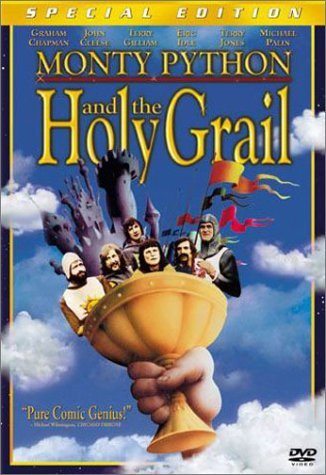 Yesterday was World Communion Sunday, and we spent time in our Sunday School classes to teach about Communion.
I was in a class of third graders. In our discussion of how "Christ and the benefits of the new covenant are represented, sealed, and applied to believers," one boy asked if Holy Grail was real.
I said, "Yes, if you mean did Jesus actually drink from a cup at the last Supper. However, the stories of King Arthur and the Grail were legends, and there is nothing magical about the cup. What’s more important is that Holy Communion is one of the ways that the Holy Spirit unites us to Jesus and each other."
To which, the children began quoting from Monty Python and the Holy Grail: "That’s the most foul, cruel, and bad-tempered rodent you ever set eyes on!" Every eight-year-old child, including the girl, was a Monty Python fan. Welcome to the Presbyterian Church!
Friday, September 29, 2006
Newsletter: Counting our Blessings
Emmett Maxon used to tell a story about two angels. One angel was called the "Gimme" angel. It was his job to answer all the requests people made in their prayers. This particular angel never had any time off. He was tired and ragged from running around handling the ever mounting pile of requests. The other angel was called the "Thank-you" angel. He managed all the prayers of gratitude and thanksgiving. This angel was always relaxed and rested. He had so little to do that he took up golf and quilting.
I think Emmett’s story reveals less about the heavenly host than it does our own humanity. We are blessed in so many ways, yet we seem to take all of it for granted. We are prone to ingratitude. Jesus himself noted this tendency. After healing ten men of leprosy, only one returned to thank him.
Our congregation has recently begun a process of discernment. As a church, we are listening carefully to God’s call and responding to that call. In our recent "Conference on the Past," we realized how blessed we are. It is now our opportunity to respond in gratitude. From now until Thanksgiving (November 23), we are counting our blessings.
We need your help. In every Sunday School class, circle meeting, committee meeting, and the like take a moment to jot down a few of God’s blessings. As families gather around the dinner table, write down a couple reasons why we are thankful. Then send them to the church. We have something to be thankful about. Let’s return and give our praise.
I think Emmett’s story reveals less about the heavenly host than it does our own humanity. We are blessed in so many ways, yet we seem to take all of it for granted. We are prone to ingratitude. Jesus himself noted this tendency. After healing ten men of leprosy, only one returned to thank him.
Jesus asked, "Were not all ten cleansed? Where are the other nine? Was no one found to return and give praise to God except this foreigner?"(Luke 17:17-18)As rare as gratitude is, it is the essence of the Christian life. Being released from the bondage of sin and reconciled to God by grace alone, we are stirred to live in thanksgiving.
Our congregation has recently begun a process of discernment. As a church, we are listening carefully to God’s call and responding to that call. In our recent "Conference on the Past," we realized how blessed we are. It is now our opportunity to respond in gratitude. From now until Thanksgiving (November 23), we are counting our blessings.
We need your help. In every Sunday School class, circle meeting, committee meeting, and the like take a moment to jot down a few of God’s blessings. As families gather around the dinner table, write down a couple reasons why we are thankful. Then send them to the church. We have something to be thankful about. Let’s return and give our praise.
Thursday, September 28, 2006
Eliminate the General Assembly?
The General Assembly Council under the new leadership of Linda Valentine is currently meeting in Louisville, Kentucky. So far, two presbyteries and a synod have asked for a “consultation” to study the “viability and stability of the synods and presbyteries of this denomination.” Clearly the intent of this request is to strengthen those lower governing bodies. No one is seriously discussing the possibility that presbyteries be eliminated.
However, Rev. Casey Jones in a letter to Presbyweb has suggested that we are putting our attention on the wrong governing body.
However, Rev. Casey Jones in a letter to Presbyweb has suggested that we are putting our attention on the wrong governing body.
While GA cannot and should not be eliminated, it (and not the "faith once and for all delivered to the saints" [Jude 3]) is what must be re-imagined, de-mythologized, de-constructed, humbled, pared down, and radically transformed, limited, and changed. Our present top-heavy, out-of-touch, and often arrogant GA structures are an important part of what is literally killing us. Will we be able to see and act on this? One can only hope.I am intrigued by the thought. The overwhelming majority of ministry and mission happens at local congregations. The presbyteries are the governing bodies closest to those local congregations providing accountability and support. In a healthy denomination, talent and financial support should be focused where it can make the biggest impact for the kingdom of God--local churches, overseas missions and the governing bodies that support them. We shouldn't have to worry about the “viability and stability” of the presbyteries. Instead our denomination is exactly upside down. The attitude seems to be that the congregations and presbyteries serve the General Assembly. We need to seriously consider why the General Assembly exists in the first place.
Wednesday, September 27, 2006
A Prayer of Confession
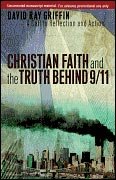 I've been avoiding this topic for a while, but I received a brochure in the mail today to which I needed to respond. Westminster/John Knox Press has recently published a book accusing the United States government with orchestrating the attacks on 9/11/2001. The brochure was titled: "Faithful, Informed and in Touch with Today's World." Amazingly, Christian Faith and the Truth Behind 9/11 by David Ray Griffin misses on every count.
I know I am a few weeks behind. Plenty of folks have already made their comments on the book. There is a great article from the Wall Street Journal about the book featuring "A Classical Presbyterian." The best line from the article is from our Moderator Joan Gray...
"To me personally, and I am sure for the great majority of Presbyterians, the idea that the United States government engineered the 9/11 attacks is too over the top to be taken seriously." (Thank you, Joan!)The denominational magazine, Presbyterians Today, has helpful analysis of the book by Alan Wisdom. Quotidian Grace quotes a "liberal" in the Christian Century complaining that the shoddy scholarship and conspiracy thinking actually hurts the legitimate critics of the Bush Administration. And in the interest of rolling eyes, here is Presbyterian Publishing Corporation's defense of the book's publication.
Why have I avoided making a comment? First, I could not fathom that anyone would be that far off the parade route. Good people can disagree with foreign policy decisions made after 9/11, but reality is reality. That took some time to digest.
Secondly, I realize now that I had been a bit selective. Although WJK has published many good books, it has also published lots of garbarge. Many titles of which contradict the historic teachings of the Church. In a way, these books are an affront to the reality of the faith. Should I be so upset about a book that questions the reality of world events while accepting books that question the revelation of God in Jesus Christ? Especially if they are from the Presbyterian Publishing Corporation?
Father forgive me.
Tuesday, September 19, 2006
Pope Benedict, Athens and Jerusalem
What should be the proper relationship between reason and Christian faith? In the third century, Tertullian asked the question, "What does Athens have to do with Jerusalem?" Pope Benedict XVI in a recent address at the University of Regensburg has answered a resounding, "everything."
This is the same speech in which the pontiff quoted a 14th Century Byzantine emperor speaking negatively about Mohammed. This is the same speech that criticizes violence done in the name of Islam, which at the same time, some Muslims use as a justification for violent acts. (I’ve stopped trying to understand that one.) Unfortunately, Benedict’s main thesis is lost in the violence that has erupted.
Benedict’s argument for the compatibility of reason and revelation is merely the reiteration of many years of Roman Catholic thought. For example, one could argue that Thomas Aquinas’ whole project hinged on making Aristotle compatible to Christian teaching. Benedict argues that the bringing together of the Athens and Jerusalem is Christianity, and Christianity is basically a European religion. Benedict says,
Benedict believes that the Reformation began the de-Hellinization of Christianity. In other words, Reformers divided Jerusalem and Athens. Kant reduced Jerusalem to a ghetto, and Harnack bulldozed much of Jerusalem to make it presentable to the modern Athens. It is not surprising that the head of the Roman Catholic Church would suggest that liberal Protestant theology was the inevitable result of Martin Luther nailing 95 theses on the Wittenberg door. It is also not surprising that I respectfully disagree.
This brings me back to Benedict’s quotes about Islam. He quotes the observations of Theodore Khoury, the editor of the 14th Century dialogue mentioned earlier.
The Reformers were not trying to remove reason from faith. Instead they were trying to keep reason humble. Even our reason is subject to sinfulness and idolatry. By starting with the self-revelation of God in Jesus Christ and the Scriptures, reason is made modest. Its ultimate role is not the discovery of the truth but instead the protection of the truth. Rather than Benedict’s Hellinization, I believe that God’s revelation makes our faith different from the Islam described by Ibn Hazn. That revelation is the corrective moving us away from idolatry, sin, and heresy. Only when we follow Jesus’ words, "abide in me," will the right relationship between faith and reason be established.
This is the same speech in which the pontiff quoted a 14th Century Byzantine emperor speaking negatively about Mohammed. This is the same speech that criticizes violence done in the name of Islam, which at the same time, some Muslims use as a justification for violent acts. (I’ve stopped trying to understand that one.) Unfortunately, Benedict’s main thesis is lost in the violence that has erupted.
Benedict’s argument for the compatibility of reason and revelation is merely the reiteration of many years of Roman Catholic thought. For example, one could argue that Thomas Aquinas’ whole project hinged on making Aristotle compatible to Christian teaching. Benedict argues that the bringing together of the Athens and Jerusalem is Christianity, and Christianity is basically a European religion. Benedict says,
This inner rapprochement between biblical faith and Greek philosophical inquiry was an event of decisive importance not only from the standpoint of the history of religions, but also from that of world history -- it is an event which concerns us even today. Given this convergence, it is not surprising that Christianity, despite its origins and some significant developments in the East, finally took on its historically decisive character in Europe. We can also express this the other way around: This convergence, with the subsequent addition of the Roman heritage, created Europe and remains the foundation of what can rightly be called Europe.This attitude explains Benedict’s concern about the recovery of Christianity in Western Europe. In his view, Europe is not Europe without the Christian faith. Moreover, it reveals one of Benedict’s fundamental critiques of Islam. To extend Tertullian’s metaphor, Islam has failed to bring Mecca and Athens together. However, the pope’s criticism here of Islam is only illustrative. He is more concerned about keeping Jerusalem and Athens firmly intertwined.
Benedict believes that the Reformation began the de-Hellinization of Christianity. In other words, Reformers divided Jerusalem and Athens. Kant reduced Jerusalem to a ghetto, and Harnack bulldozed much of Jerusalem to make it presentable to the modern Athens. It is not surprising that the head of the Roman Catholic Church would suggest that liberal Protestant theology was the inevitable result of Martin Luther nailing 95 theses on the Wittenberg door. It is also not surprising that I respectfully disagree.
This brings me back to Benedict’s quotes about Islam. He quotes the observations of Theodore Khoury, the editor of the 14th Century dialogue mentioned earlier.
But for Muslim teaching, God is absolutely transcendent. His will is not bound up with any of our categories, even that of rationality. Here Khoury quotes a work of the noted French Islamist R. Arnaldez, who points out that Ibn Hazn went so far as to state that God is not bound even by his own word, and that nothing would oblige him to reveal the truth to us. Were it God's will, we would even have to practice idolatry.I must admit that when I read this description of Islam, I immediately thought of some Presbyterians that are so enamored with the sovereignty and freedom of God that they forget the incarnation. I am reminded of those Presbyterians who claim that the Holy Spirit would speak in contradiction to Jesus Christ or the Scriptures. Benedict sees this as a failure of reason. I see it as a failure to embrace revelation.
The Reformers were not trying to remove reason from faith. Instead they were trying to keep reason humble. Even our reason is subject to sinfulness and idolatry. By starting with the self-revelation of God in Jesus Christ and the Scriptures, reason is made modest. Its ultimate role is not the discovery of the truth but instead the protection of the truth. Rather than Benedict’s Hellinization, I believe that God’s revelation makes our faith different from the Islam described by Ibn Hazn. That revelation is the corrective moving us away from idolatry, sin, and heresy. Only when we follow Jesus’ words, "abide in me," will the right relationship between faith and reason be established.
Sunday, September 17, 2006
A Matter of Polity
A few days ago, I heard a member of a member of another Presbyterian church tell this joke:
Too often we seem to conflate the leadership of a governing body for the body itself. I have seen pastors treat sessions as extensions of themselves. I have seen presbytery executives assume that their opinions have the weight of the presbytery behind them. Many buy into the ruse. More than once during debate at a presbytery meeting concerning an overture from a particular session, some asked the pastor about "his or her overture." Such actions are contrary to Presbyterian governance.
Another example of poor polity comes from the "double super secret" documents drafted by denominational lawyers addressing property concerns. From what I understand, those documents were distributed to some presbytery executives as early as 2002. The documents were labeled as "confidential" or "do not distribute." Why should the presbytery itself be kept in the dark? Isn’t the presbytery the governing body, not the executive? In fact, I would argue that the executive works only at the discretion of the presbytery. Historically, presbyteries did not even have executives. Bypassing the normal governing bodies suggests that someone was trying to hide something (even if they weren't).
Our polity indicates we are ruled by elders. Unfortunately, our practice doesn’t always agree.
Two dogs meet in a park. On says, "I am a St. Bernard. I help save people." The other responds, "I don’t know what I am. I must be a Presbyterian."I believe that many of our problems in our denomination are rooted in an identity crisis. We have real doubts about what it means to be Reformed, Presbyterian and in some cases, Christian. Lately, I have been concerned about the lack of understanding of basic Presbyterian polity among our leadership. Our congregation has recently received a pastoral letter from the Synod exec of the Synod of the Sun. In the letter, Judy Fletcher wrote...
With leaders from all 11 presbyteries in this synod, we worshipped, prayed and considered the needs of Presbyterians. In congregation after congregation there are people like you trying to be faithful to Christ and diligent in mission and ministry. That was just as true before the Assembly...Now, I was grateful to hear that those in attendance--presbytery executives, staff members, members of Committees of Ministry, moderators of presbyteries, etc–agreed to uphold our constitution. However, those people do not speak for the presbytery as a whole. The language of "affirmed" suggests that a formal action was taken. None was. I will not question anyone’s motives here, but the synod executive’s opinion doesn’t carry much weight. For example, Mission Presbytery’s recent actions along with the synod’s Permanent Judicial Council’s ruling appears to contradict the Synod executive’s letter. Someone sitting in a pew would be baffled again at more confusing language coming from the leadership of the church.
All 11 presbyteries affirmed that the Book of Order has not changed and the ordination of non-celibate gay and lesbian persons is still prohibited. Presbyteries expressed commitment to uphold our constitution.
Too often we seem to conflate the leadership of a governing body for the body itself. I have seen pastors treat sessions as extensions of themselves. I have seen presbytery executives assume that their opinions have the weight of the presbytery behind them. Many buy into the ruse. More than once during debate at a presbytery meeting concerning an overture from a particular session, some asked the pastor about "his or her overture." Such actions are contrary to Presbyterian governance.
Another example of poor polity comes from the "double super secret" documents drafted by denominational lawyers addressing property concerns. From what I understand, those documents were distributed to some presbytery executives as early as 2002. The documents were labeled as "confidential" or "do not distribute." Why should the presbytery itself be kept in the dark? Isn’t the presbytery the governing body, not the executive? In fact, I would argue that the executive works only at the discretion of the presbytery. Historically, presbyteries did not even have executives. Bypassing the normal governing bodies suggests that someone was trying to hide something (even if they weren't).
Our polity indicates we are ruled by elders. Unfortunately, our practice doesn’t always agree.
Monday, September 11, 2006
Our Community
I just e-mailed this letter to the editor of our local newspaper...
Dear Editor,
On the fifth anniversary of the worst attack on American soil, a group of people gathered in front of the downtown fire station our small town. We are far away from New York City, Washington, DC, and Shanksville, Pennsylvania, yet this little town south of the Red River understands community in a way that extends beyond geography.
Since my family moved here in 2003, I have again and again been impressed with the sense of community here. I have experienced it among the pastors and church members here. I have seen it in the precious time that many in our town give to volunteer work. I have witnessed it as the community rallies around folks in need. What other community of our size can boast of so many active clubs, organizations, and groups? As people decry the isolation and individualism of the modern world and small towns disband service organizations due to lack of interest, this town surprises me.
True, we face some huge challenges. The social problems of the world are here–substance abuse, teenage pregnancy, broken families, and the like. We wring our hands over them like everyone else. There are many even within our midst who are lonely and disconnected. Still, I have hope because of the grace God has already given us. Our sense of community suggests a way forward.
9/11 reminded us of words like sacrifice, compassion, faith, and community, yet they are more than words. They are a calling to a way of life. Perhaps I am naive, but I think our city just might be receptive to that call.
September 11th
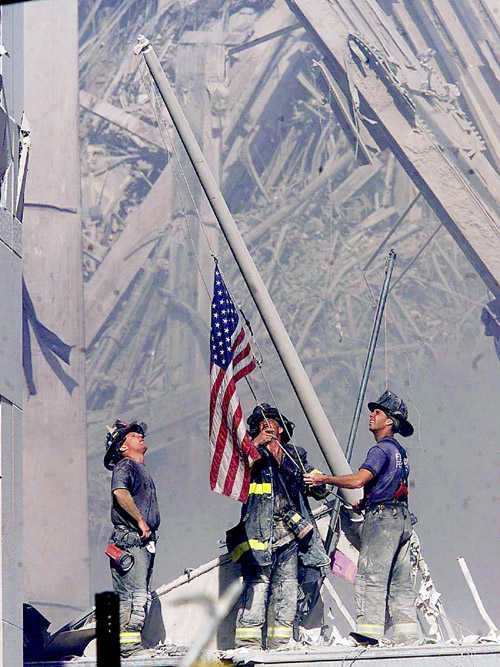
Five years ago, we were reminded that evil is real, that heroes exist, and that hope never dies. Despite her sins, America remains a beautiful, wonderful land whose greatest resource is her people. Let us not forget those who died, those who mourn, and the children whose parents are never coming home.
"Oh, that my words were recorded, that they were written on a scroll, that they were inscribed with an iron tool on lead, or engraved in rock forever! I know that my Redeemer lives, and that in the end he will stand upon the earth" (Job 19:23-25).
Subscribe to:
Posts (Atom)